

How to Choose Kitchen Tools for Small Spaces: The Complete Guide (2026)
I Bought Everything. I Regretted Most of It.
Learning how to choose kitchen tools for small spaces took me years of trial and error. When I moved into my first apartment, I made every mistake possible. I bought gadgets I never used. I trusted “compact” labels that lied. I wasted money and space.
This guide will teach you how to choose kitchen tools for small spaces so you don’t make the same mistakes I did.
I bought a garlic press. Used it twice. It lives in a drawer somewhere.
I bought a mandoline slicer. Scared myself. Never used it again.
I bought three different “space-saving” gadgets that took up more space than they saved.
Years later, my kitchen is smaller than that first apartment. But my tool collection is smarter. I’ve learned what works and what’s just taking up space.
This guide is everything I wish someone told me before I wasted money on kitchen tools I didn’t need.
The 5 Questions Every Small Kitchen Owner Must Ask
Before you learn how to choose kitchen tools for small spaces, you need to ask yourself five honest questions.
Question 1: Will It Actually Fit?
When learning how to choose kitchen tools for small spaces, measuring is the most important skill.
The measurement rule:
Never trust “compact” claims. Trust measurements.
Before buying anything:
- Measure your available counter space
- Measure cabinet space for storage
- Add 2 inches for clearance around appliances
- Write these numbers down
The tape measure test:
When you find a product, look for actual dimensions. Width × Depth × Height.
Then compare to your measurements. If it’s close, it probably won’t fit.
Real example:
An air fryer claims 11 inches wide. Your counter is 12 inches. Sounds fine, right? But you need space around it. Heat needs to escape. The cord needs room. Suddenly 11 inches needs 14 inches.
Always leave breathing room.
Question 2: Will I Actually Use It?
This is the hardest question. We buy tools for the cooks we want to be, not the cooks we are.
The truth test:
Look at your cooking habits from the last month.
- Did you bake? If not, you don’t need a stand mixer.
- Did you chop vegetables every day? If yes, a good knife matters.
- Did you make coffee at home? If yes, invest in a coffee maker.
The 30-day rule:
Want a specialty tool? Wait 30 days. If you still want it, still need it, and have space for it, consider buying.
Tools most people don’t need:
- Garlic press (knife works fine)
- Avocado slicer (knife works fine)
- Egg slicer (knife works fine)
- Single-use gadgets (they multiply)
Tools most people actually use:
- Good chef’s knife
- Cutting board
- Mixing bowls
- Measuring cups and spoons
- Colander
- Pots and pans (2-3 sizes)
Question 3: Can It Do More Than One Thing?
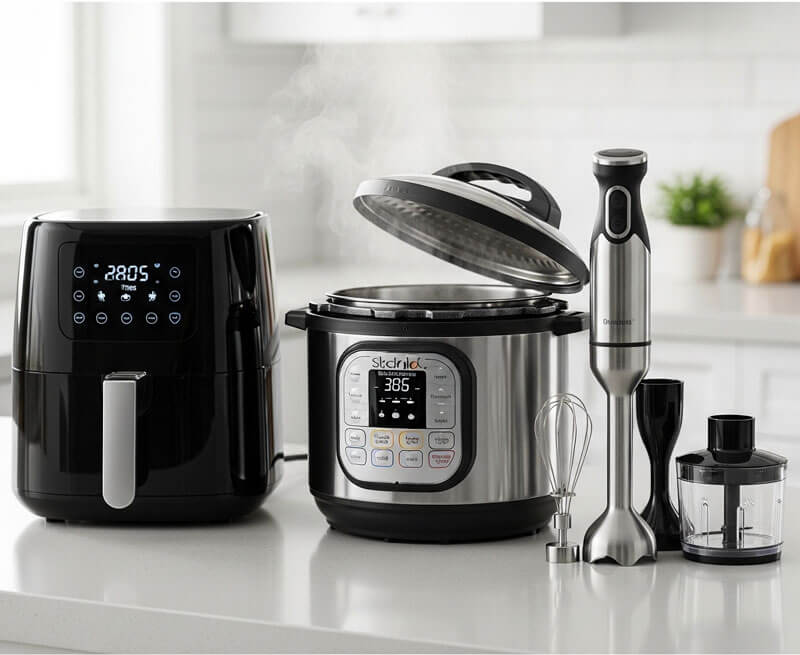
In small kitchens, multi-function tools win.
Look for:
- Air fryers that also bake, roast, dehydrate
- Immersion blenders that also chop, whisk
- Instant Pots that pressure cook, slow cook, sauté
- Toaster ovens that toast, bake, broil
The math:
One multi-function tool replacing three single-use tools = two cabinet spaces saved.
What to avoid:
Single-use gadgets that do one thing and one thing only.
- Egg cooker
- Rice cooker (unless you eat rice daily)
- Bread machine
- Panini press
Worth considering:
- Instant Pot (replaces 5+ appliances)
- Air fryer toaster oven combo (replaces toaster + air fryer + oven)
- Immersion blender (replaces blender + whisk + food processor)
Question 4: Can I Store It When Not in Use?
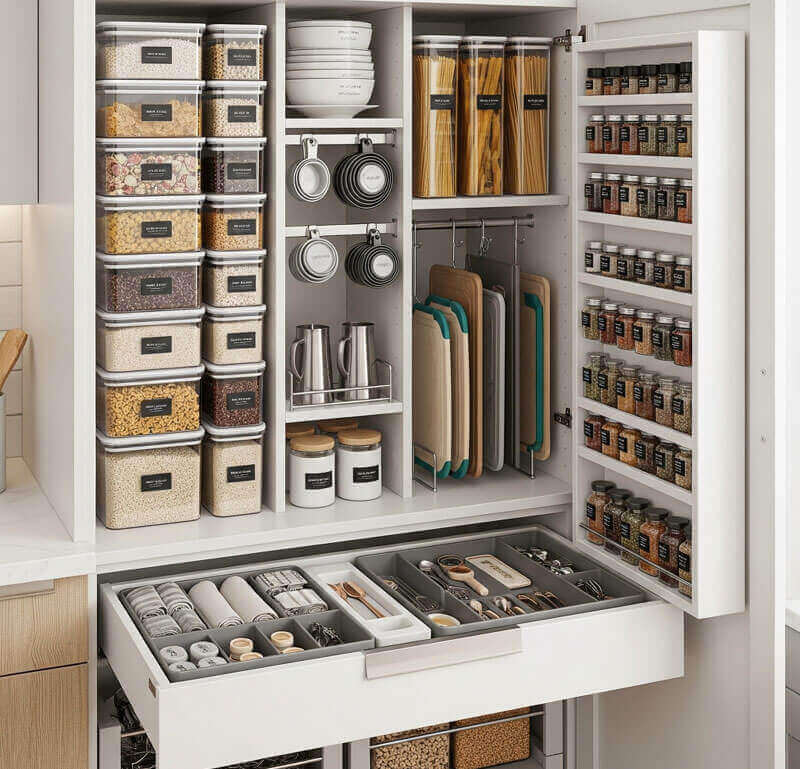
Every tool needs a home. Not just counter space, but storage space.
The storage audit:
Open your cabinets. Look at the space.
- What’s actually in there?
- What could be removed?
- Where will new tools go?
Storage-friendly features:
- Foldable handles
- Removable cords
- Stackable design
- Vertical storage option
- Light enough to move
Red flags:
- Awkward shapes that don’t stack
- Permanent counter placement required
- Heavy and hard to move
- Needs special storage (like hanging)
The cord test:
Can the cord wrap neatly? Long cords that dangle cause storage problems. Look for cord storage underneath.
Question 5: Will It Annoy My Neighbors?
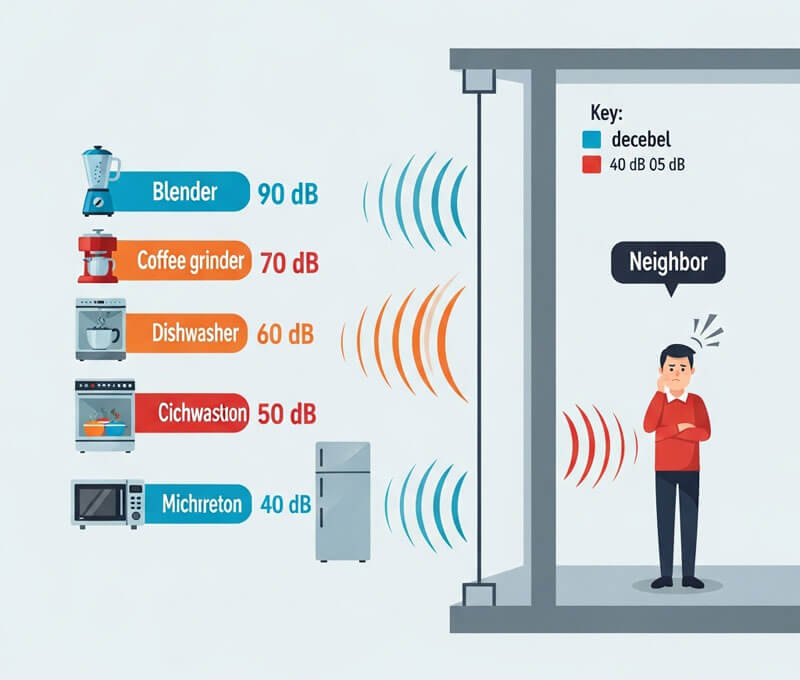
Apartment living means shared walls. Noise matters.
The decibel reality:
- 50-55 dB: Normal conversation (safe)
- 55-60 dB: Noticeable but fine
- 60-65 dB: Annoying for neighbors
- 65+ dB: Problematic
What makes noise:
- Blenders (loudest offenders)
- Food processors
- Dishwashers
- Air fryers with loud fans
What to look for:
- Noise ratings in decibels
- “Quiet operation” claims with actual numbers
- Reviews mentioning noise specifically
- Models with noise insulation
The neighbor test:
Search reviews for “noise” and “neighbor.” If multiple people complain, believe them.
The Essential Small Kitchen Toolkit
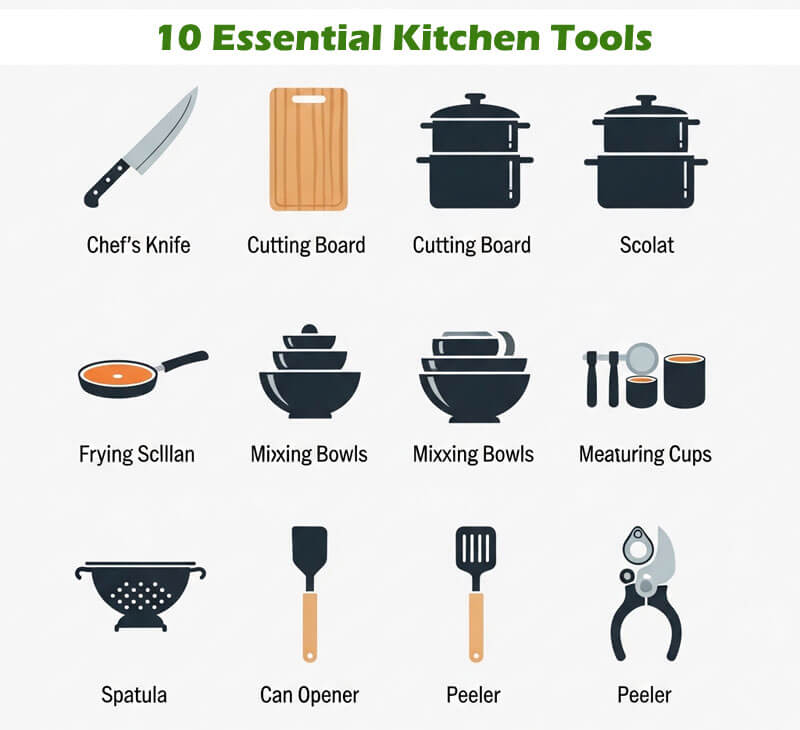
After years of learning how to choose kitchen tools for small spaces, here’s what you actually need.
The Absolute Essentials:
- Good chef’s knife (8-inch, stays sharp)
- Cutting board (wood or plastic, fits your sink for cleaning)
- 2 pots (small and medium, with lids)
- 1 skillet (10-12 inch, nonstick or cast iron)
- Mixing bowls (2-3 sizes, nesting)
- Measuring cups and spoons (one set each)
- Colander (collapsible if space is tight)
- Spatula, wooden spoon, tongs (one each)
- Can opener (doesn’t need to be fancy)
- Vegetable peeler (the Y-shaped kind works best)
The Nice-to-Haves (After Essentials):
- Air fryer (if you like crispy food)
- Coffee maker (if you drink coffee daily)
- Immersion blender (for soups and smoothies)
- Toaster (if you eat toast, but consider toaster oven)
- Food storage containers (stackable, matching lids)
The “Maybe Later” List:
- Stand mixer (only if you bake regularly)
- Food processor (only if you cook elaborate meals)
- Rice cooker (only if you eat rice 3+ times weekly)
- Specialty gadgets (only if you have space and need)
See our tested recommendations:
Red Flags: What to Avoid at All Costs
1. “As Seen on TV” gadgets
They look amazing in commercials. They’re terrible in real kitchens. They break fast, work poorly, and clutter drawers.
2. Sets with too many pieces
That 20-piece knife set? You’ll use 2 knives. The rest live in a block taking space. Buy individual quality pieces instead.
3. Cheap versions of expensive tools
A $20 chef’s knife won’t stay sharp. A $50 blender won’t crush ice. Buy the best you can afford, or wait and save.
4. Anything you can’t easily clean
If it has crevices, weird shapes, or “easy clean” promises, assume cleaning will be hard. Look for dishwasher-safe and smooth surfaces.
5. The “maybe someday” purchase
Don’t buy a bread maker because you might bake bread someday. Buy it after you’ve baked bread by hand for months and know you’ll keep doing it.
The Space-Saving Shopping Strategy
Step 1: Make a list
Write down what you actually need. Not what you want. What you need for the cooking you actually do.
Step 2: Measure everything
Measure your space. Write it down. Keep it on your phone. When you see a product, compare immediately.
Step 3: Read reviews with purpose
Search reviews for:
- “Small kitchen”
- “Apartment”
- “Noise”
- “Storage”
- “Counter space”
Step 4: Buy one thing at a time
Don’t buy everything at once. Get one tool. Use it for a week. See if it earns its space.
Step 5: Return what doesn’t work
Amazon returns are easy. If it doesn’t fit, doesn’t work, or doesn’t earn its spot, send it back.
Frequently Asked Questions
Q: How many kitchen tools do I really need?
A: Start with 10-15 essentials. Add slowly. Most small kitchens function well with 20-25 quality tools. The rest is clutter.
Q: Should I buy cheap or invest in expensive tools?
A: Hybrid strategy. Buy cheap for things that don’t matter (measuring cups, spatulas). Invest in things you use daily (knife, pots, appliances).
Q: What’s the biggest space-waster in most kitchens?
A: Single-use gadgets. Garlic presses, avocado slicers, egg cookers. They take space and get used once.
Q: How do I know if a tool is good quality?
A: Read reviews. Look for patterns. If 100 people say it breaks after 3 months, believe them. If 100 people say it’s lasted years, that’s a good sign.
Q: What should I look for in apartment-friendly appliances?
A: Size measurements, noise ratings, cord length, storage options, and multi-function capability.
Final Advice From Someone Who Learned the Hard Way
I’ve wasted hundreds of dollars on kitchen tools I didn’t need. I’ve bought “compact” appliances that didn’t fit. I’ve filled drawers with gadgets I used once. The hardest part of learning how to choose kitchen tools for small spaces is being honest with yourself.
Here’s what I wish I knew then.
Your kitchen doesn’t need more stuff. It needs better stuff.
Quality over quantity. Multi-function over single-use. Actual measurements over marketing claims.
Start with the basics. Use them. Learn what you actually need.
Then add slowly. One tool at a time. Each one earning its space.
Because in a small kitchen, every inch matters. Every tool should earn its spot.

Disclosure: As Amazon Associates, we earn from qualifying purchases at no extra cost to you. This guide comes from years of trial and error in actual small kitchens.
2 Comments