How To Use A Cuisinart Food Processor
How to use a Cuisinart food processor starts with choosing the right attachment, loading the bowl without crowding it, and using short pulses when you need more control. A Cuisinart food processor can chop, slice, shred, puree, and mix ingredients much faster than doing everything by hand. These simple basics make it easy to prepare cookie dough, coleslaw, salsa, pie filling, and many other recipes without turning ingredients into paste.
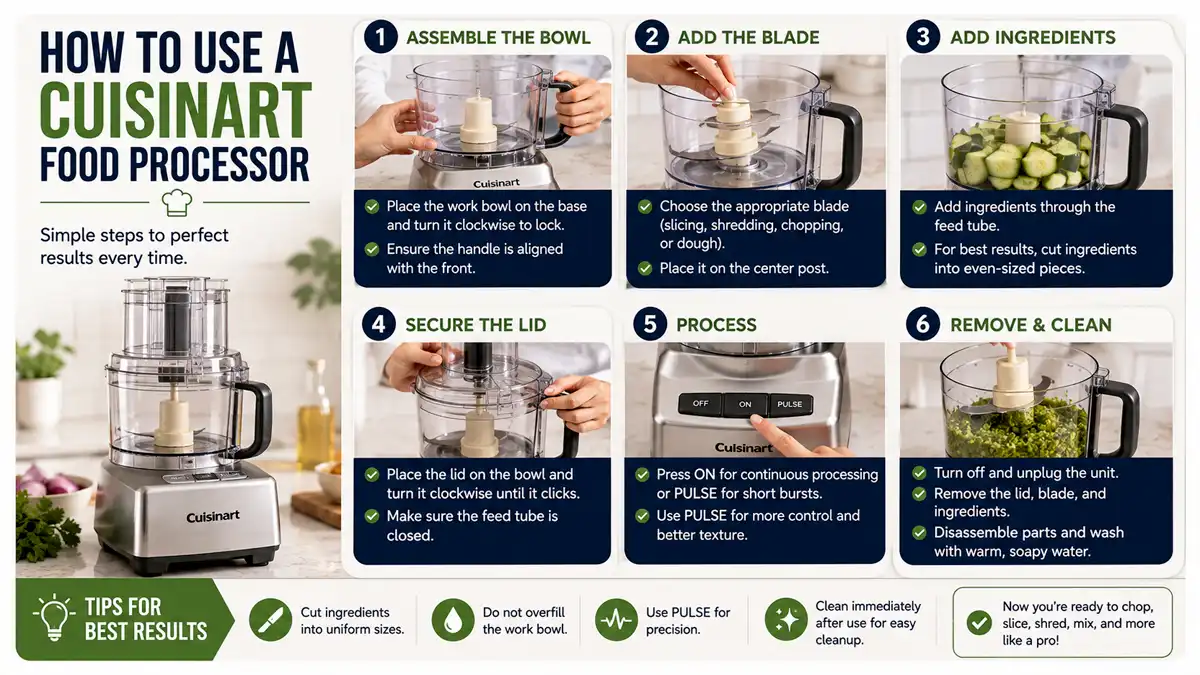
The process is simple: assemble the bowl, lock the lid, install the blade or disc, then pulse or run the machine until the food reaches the texture you want. Start with short pulses for chopping and dough. If food stops moving, turn the processor off and use a spatula to reposition it. Never reach into the bowl while the blade or disc is moving.
Key Takeaways
- Choose the right attachment. Use the work bowl blade for chopping and purees, and the shredding or slicing discs for even results.
- Load the bowl lightly. Overfilling slows processing and creates uneven pieces.
- Pulse for control. Short pulses help keep chunks from turning into paste.
- Lock the lid fully. The processor typically will not run if the lid is not seated correctly.
- Feed through the chute. Use the pusher instead of your fingers or utensils.
- Stop and scrape often. Pause to rearrange food for a more uniform texture, especially with thick mixtures.
Set Up Your Cuisinart Food Processor
Before pressing any buttons, gather the parts you need: the work bowl, lid with feed chute, pusher, and the correct blade or disc. Depending on the task, that may be the chopping blade, dough blade, slicing disc, or shredding disc. Most Cuisinart models use the same basic arrangement: the bowl locks onto the base, the lid locks onto the bowl, and the blade or disc fits over the center spindle.
Keep the processor unplugged while you assemble it. Clear enough counter space to work safely, set out a spatula for scraping, and keep a clean towel nearby if you are processing wet ingredients such as tomatoes.
If you are new to food processors, start with a forgiving task. Chopping onions teaches pulse control, while slicing or shredding cheese helps you learn how much pressure to use with the feed pusher.
Use Pulse and Continuous Processing Correctly
Most food processor tasks use one of two settings: pulse for control or continuous processing for speed and uniformity. Pressing and releasing the pulse button in short bursts lets you check the texture as you go. Continuous processing works better for thin batters, fine crumbs, and smooth purees once you know how quickly the food changes.
A very small load can be difficult to process because the blade may not catch everything, forcing you to stop and scrape more often. Adjust the batch size when ingredients are not moving effectively.
Use the feed chute for slicing and shredding. Add small amounts through the chute and guide them with the provided pusher. If food jams, stop the machine first, then reposition it with a spatula.

Helpful pick
Cuisinart 5‑Cup Chop & Shred Food Processor, Compact Food Chopper, Easy‑Store Design, Silver FP-5
This compact processor is excellent for mastering pulse control, allowing you to achieve the perfect texture for small batches of dips or sauces.
How to Use a Cuisinart Food Processor Step by
- Unplug the processor. Keep it off while assembling the work bowl, blade, and lid.
- Lock the work bowl onto the base. Place the bowl on the motor unit and rotate it until it sits securely.
- Install the correct attachment.
– For chopping, mincing, and many purees, use the standard work bowl blade.
– For slicing or shredding, use the appropriate disc and position it correctly over the center spindle.
- Add food in batches. Cut large ingredients into pieces that fit comfortably, and avoid filling the bowl to the brim.
- Lock the lid and insert the pusher. Make sure the lid is fully seated and the chute is aligned.
- Pulse or run the processor to reach your target texture. Start with short pulses for controlled chopping, then run it briefly if you want a finer result.
- Check the texture and scrape down the bowl. Stop the machine, open the lid, and move food from the sides toward the blade so it processes evenly.
- Unplug before removing parts. Take out the blade or disc only after the power is off, then clean the parts promptly.
Chopping Onions
Cut the onions into wedges, add a moderate amount to the bowl, and pulse 6-10 times before checking the texture. Short pulses give you more control than a long continuous run. Stop as soon as the onions reach the size you want; continued processing can quickly turn them into a wet, uneven mixture.
Shredding Carrots for Coleslaw
Install the shredding disc and prepare the carrots so they slide into the feed chute. Feed them with steady pressure. Pushing too hard can overload the chute and slow the output, while using too little pressure can leave unshredded strips.

Helpful pick
Cuisinart Food Processor, Dishwasher Safe 11-Cup Food Processor with Slicing & Shredding Discs, Cuisinart Pro Custom 11 Stainless Steel Electric Chopper & Kitchen Food Processor, Chrome, DLC-8SBCYP1
The Pro Custom 11 is an ideal choice for those learning the assembly process, featuring intuitive parts that lock securely for safe operation.
Match the Attachment to the Food
The attachment determines the texture. Use the work bowl blade and pulse for rough-chopped salsa. Use the shredding disc for consistent grated cheese. Use the blade for hummus or a soup base, processing until the mixture becomes cohesive and stopping to scrape when food sticks to the bowl.
Before processing, cut ingredients into predictable sizes. Similar-sized onion wedges produce more even pieces. Break large nuts into smaller pieces so they do not jam in the feed chute or spin around the bowl without being processed.
Use Short Pulses for Chopping
Start with the rule “short, check often.” For medium-chopped food, try 3-5 pulses, check the texture, and repeat as needed. A long continuous run can overprocess ingredients before you have a chance to stop the machine.
Handle Dough and Thick Mixtures Carefully
Thick dough can climb the sides of the bowl or stick, depending on the moisture level and batch size. Smaller batches usually circulate more effectively. If your model allows easy access, stop occasionally to scrape the bowl.
Stop and reassess if the dough becomes too tight or the motor strains. Continuing to run a struggling processor puts unnecessary stress on the motor and attachments.
Add Liquids With Care
Wet ingredients behave differently from solids. Do not pour in huge amounts all at once unless your recipe and bowl capacity support it. For hot recipes, follow your appliance’s safety guidance because lid design, sealing, and splatter risk vary by model.
Make Processing More Consistent and Safer
Steady feeding produces more consistent slices and shreds. Use the pusher to guide food through the chute, but do not force it quickly. If the output contains unprocessed gaps, slow down and feed smaller pieces.
Rinse or wipe the bowl soon after use. Sticky dough and thick sauces become harder to remove as they dry, and they can leave odors or stains. If your model has removable blades and discs, handle those parts carefully and clean them promptly.
💡 The extra-large feed tube on this model makes it significantly easier to feed ingredients steadily for consistent, professional-looking slices and shreds. Cuisinart Food Processor, Extra-Large Feed Tube, 625 W, 11-Cup Capacity.
Avoid These Cuisinart Food Processor Mistakes
Ignoring unusual motor sounds or resistance can lead to unnecessary wear. Stop the machine when the motor strains or food jams, unplug the processor if needed for safe handling, and remove or reposition the food before continuing.
Inspect the attachment and bowl after processing. Food caught beneath a disc or around the spindle can affect the next batch, while residue left on the lid or feed chute can make later feeding messy.
Practical Ways to Improve Results
Chill or freeze sticky ingredients when appropriate. Cold butter behaves differently from warm butter in pastry dough, and cold cheese usually grates more predictably than room-temperature cheese. For fine crumbs, use short pulses instead of running the processor continuously.
For repeatable chopping, keep track of your pulse count. You may find that a certain number of pulses produces coarse walnuts, while more pulses turn them closer to a meal-like texture. Using a repeatable count makes future batches easier to control.
Keep the lid and feed chute clean between batches. Sauce and moisture can smear inside the chute and reduce feeding efficiency, especially when using slicing discs. A quick wipe can prevent messy, uneven reprocessing.

Helpful pick
Cuisinart 7-Cup Pro Classic Food Processor, 600-Watt Motor, Vegetable Chopper & Blender for Mincing, Dicing, Shredding, Puree & Kneading Dough, DLC-10SYP1, White
This 7-cup classic model is perfect for handling chilled ingredients like butter for pastry, providing the control needed for delicate, consistent results.
FAQ
How much food can I put in a Cuisinart food processor?
Use a conservative batch size at first, and switch to smaller batches if the food stops moving around the bowl. Cut large ingredients into smaller, similar pieces so the blade can catch them more evenly.
Why won’t my Cuisinart food processor start?
Most starting problems come from assembly and safety interlocks. Check that the work bowl is locked correctly, the lid is fully seated, and the pusher is installed as required. Confirm that the unit is plugged in and that the blade or disc is positioned correctly over the center spindle.
How long should I run it to avoid overprocessing?
Start with short pulses, then use brief continuous runs only when you are close to the desired texture. For many chopping tasks, several short pulses work better than one long run because you can check the food sooner. If the mixture becomes paste-like too quickly, shorten the pulses.
Can I use my food processor to make dough?
Yes, although dough is thicker than most ingredients and may require smaller batches and closer monitoring. Use the dough blade if your model includes one, and add ingredients as your recipe directs. If the dough climbs the sides or the motor strains, stop and reduce the batch size.
What’s the most common mistake people make?
People commonly overfill the bowl or let the processor run too long. Both choices make it harder to control texture. Use moderate batches and check the food frequently as it processes.