How Many Tablespoons Of Coffee For 4 Cups Water Explained Simply
Making coffee at home should not require a chemistry degree, yet most people ruin their brew by guessing the measurements. You grab a scoop and pour, hoping for the best, but the result is often a bitter sludge or a watery cup that lacks any depth of flavor. Getting the ratio right changes everything from the morning routine to the overall enjoyment of the beverage.
For 4 cups of water, you need between 4 and 8 tablespoons of ground coffee, depending on the strength you prefer. A standard starting point uses 1 tablespoon per 6 ounces of water, which means 4 cups (32 ounces) requires 5 to 6 tablespoons for a balanced brew.
Four cups of water equals 32 ounces, requiring 4 to 8 tablespoons of coffee.
Use 1 tablespoon per 6 ounces for standard strength coffee.
Two tablespoons per 6 ounces creates a bold, strong cup.
Measuring by weight (grams) is more accurate than volume (tablespoons).
Different brew methods like French Press and Pour-Over require different ratios.
How Many Tablespoons of Coffee for 4 Cups of Water

You need 4 to 8 tablespoons of coffee for 4 cups of water. The “4 cups” in your recipe usually refers to the water capacity of your coffee maker, which typically brews 5-ounce cups, or it might refer to the liquid volume you want in your travel mug. Standard brewing ratios usually recommend one level tablespoon of coffee grounds for every 6 ounces of water.
A standard 12-cup drip coffee maker actually brews about 48 ounces of liquid, not 96 ounces, because manufacturers define a “cup” as 5 ounces. If your goal is to fill a standard 12-ounce travel mug four times, you need to adjust your coffee amount accordingly, as that requires closer to 8 tablespoons for a strong cup.
Using a kitchen scale is the only way to guarantee consistency, but if you are measuring by volume, you must distinguish between a level tablespoon and a heaping one. A level tablespoon contains roughly 5 to 6 grams of coffee, while a heaping tablespoon can hold up to 8 grams. For a standard 32-ounce batch, 4 tablespoons will produce a weak, under-extracted cup, while 8 tablespoons will result in an over-extracted, bitter brew that tastes like mud.
Standard Coffee to Water Ratios for 4 Cups
The standard ratio for drip coffee is 1:16 by weight. This means for every 16 grams of water, you use 1 gram of coffee. This ratio produces a balanced flavor profile that highlights the bean’s origin notes without being overwhelmed by bitterness or sourness.
For a 32-ounce batch (4 standard cups), the math works out to needing 2 ounces of coffee beans. Since 1 ounce of coffee beans weighs approximately 28.35 grams, this translates to 56.7 grams of coffee. Converting that back to tablespoons, 56.7 grams is roughly equivalent to 10 to 12 tablespoons of ground coffee.
Most home brewers struggle with these precise numbers because they rely on volume measurements rather than weight. A tablespoon of light roast coffee fills more space than a tablespoon of dark roast because the beans are less dense. Consequently, a 1:16 ratio measured in tablespoons will produce a weaker cup with a light roast and a stronger cup with a dark roast, simply due to the density differences.
Common Ratio Breakdown for 32 Ounces of Water
| Strength Level | Ratio (Coffee:Water) | Grams of Coffee | Tablespoons |
|---|---|---|---|
| Weak / Light | 1:18 | 50g | 9 tbsp |
| Balanced | 1:16 | 56g | 10 tbsp |
| Strong | 1:14 | 64g | 12 tbsp |
Measuring Coffee Using Tablespoons vs. Grams
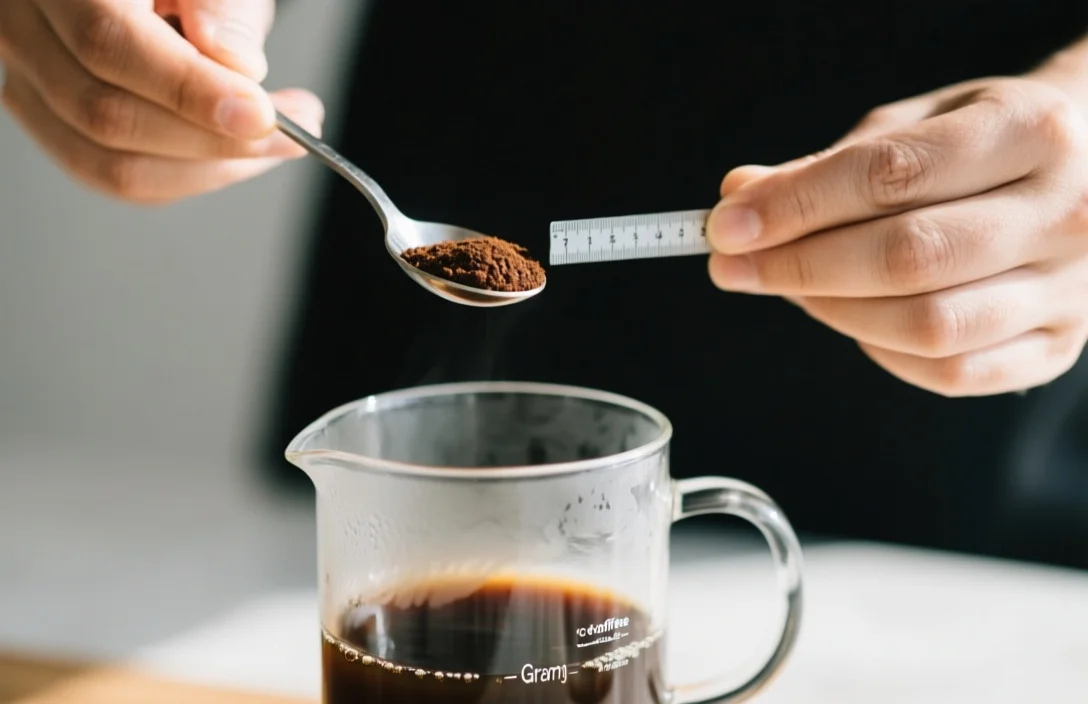
Tablespoons are convenient, but grams are precise. When you measure by volume, you are measuring the air pockets between the coffee particles. These air pockets vary depending on how coarsely or finely you grind the beans, how much you tamp the coffee in the scoop, and the density of the roast itself.
Using a kitchen scale eliminates these variables entirely. If you want to hit that 1:16 ratio perfectly, you would weigh out 56 grams of coffee, regardless of whether it looks like a small mountain or a flat layer in your scoop. This consistency ensures that your coffee tastes the same every single morning, even if you buy a different brand of beans.
For the average drinker who does not own a scale, a good rule of thumb is to use two tablespoons for every 6 ounces of water for a standard strength. If you prefer a stronger cup, stick to three tablespoons. If you find your coffee is too bitter, drop down to one tablespoon. This trial-and-error method is often faster than weighing ingredients for a single cup.
Adjusting Coffee Strength for Different Brew Methods
French Press needs more coffee than a pour-over. Immersion brewing methods like the French Press or Cold Brew extract flavor much more aggressively than drip or pour-over systems. The coffee grounds sit in hot water for several minutes, which pulls out oils and solids that paper filters trap in a standard drip machine.
For a French Press using 32 ounces of water, you should use between 6 and 8 tablespoons of coffee. This higher ratio compensates for the fact that French Press coffee is naturally stronger and more full-bodied. If you use the standard 5 tablespoons recommended for drip coffee, your French Press will taste thin and watery.
Pour-over and drip machines work differently because they use gravity to pull water through the coffee bed. The water only contacts the grounds for a brief moment. To compensate for this shorter contact time, you actually need slightly more coffee per ounce of water than you do for a French Press. A 1:15 or 1:16 ratio is ideal for these methods to ensure the water extracts enough flavor before it passes through the filter.
Calculating Coffee Amounts for Specific Water Volumes
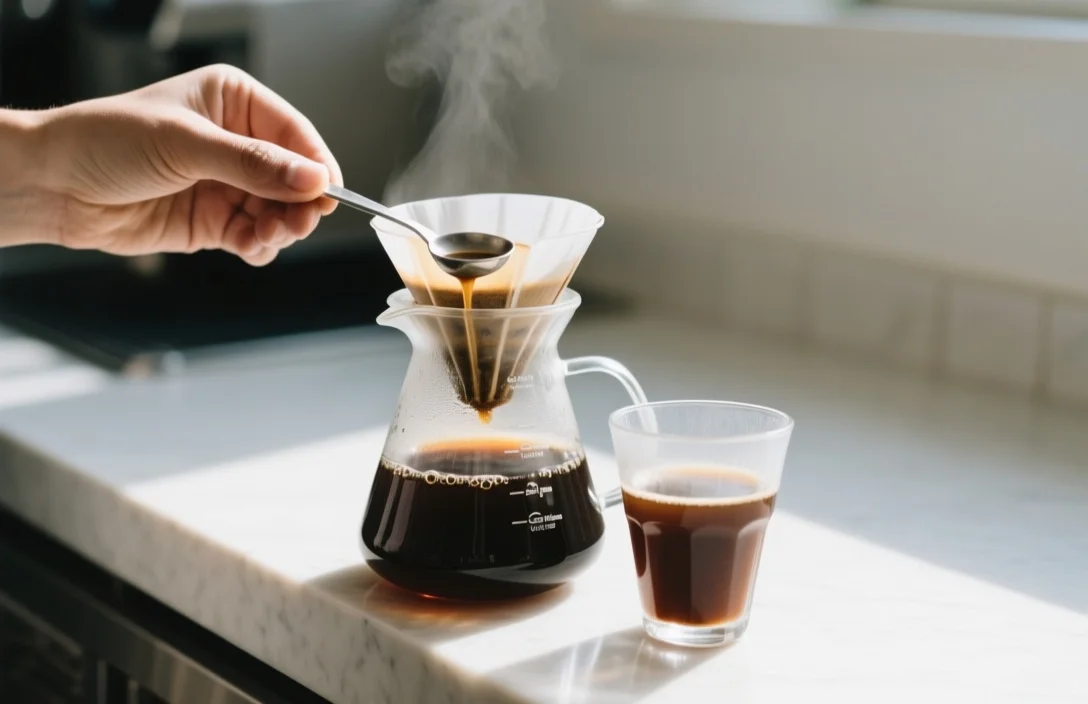
Always measure water, not just “cups.” The term “cup” is ambiguous in the coffee world. A standard coffee mug holds 12 to 16 ounces, while a “cup” in the context of a coffee maker is often defined as 5 or 6 ounces. If you brew 32 ounces of water into a 16-ounce mug, you are making only two mugs of coffee, but you are using the ratio for four.
To get the math right, convert your volume into milliliters or ounces. 4 standard cups of water equals 32 fluid ounces or approximately 950 milliliters. If you are brewing for a crowd using a large carafe, you might be using 4 standard mugs worth of water, which would be 48 to 64 ounces.
If you are brewing 64 ounces of water (which is the size of a standard 3-liter pitcher), you should scale your recipe up proportionally. Using the 1:16 ratio, 64 ounces of water requires 4 ounces of coffee. Since 1 ounce of coffee is about 28 grams, you need 112 grams of coffee, which is roughly 20 tablespoons. This scaling method ensures that the flavor remains consistent no matter how large your batch is.
Common Coffee to Water Ratio Conversions
A quick reference table helps you scale your brewing for any occasion. Whether you are making a single cup for yourself or a full pot for guests, knowing the exact measurements prevents waste and ensures everyone gets a drink they enjoy.
Scaling Ratios for Common Batch Sizes
| Water Volume | Standard Ratio (1:16) | Grams of Coffee | Tablespoons |
|---|---|---|---|
| 2 Cups (16 oz) | 1:16 | 28g | 5 tbsp |
| 4 Cups (32 oz) | 1:16 | 56g | 10 tbsp |
| 6 Cups (48 oz) | 1:16 | 85g | 15 tbsp |
| 8 Cups (64 oz) | 1:16 | 113g | 20 tbsp |
FAQ
Is a tablespoon of coffee level or heaping?
You should use a level tablespoon for the most consistent results. A heaping tablespoon can vary significantly in weight, ranging from 8 to 10 grams, which will throw off your ratio and make the coffee too strong. Most coffee scoops are designed to be level, so simply filling the scoop to the brim is usually the easiest method.
Does the grind size change the amount of coffee I need?
The grind size does not change the total amount of coffee you need by weight, but it changes how much flavor you extract. A finer grind extracts faster, so you might get away with slightly less coffee if you over-extract, but this usually leads to bitterness. A coarser grind requires more coffee to compensate for the lack of extraction.
Can I use a mug instead of a “cup” when measuring?
Yes, you should measure the liquid in your mug to be accurate. If your mug holds 16 ounces, you need to use the ratio for 2.5 cups of water, not 1 cup. Using the wrong volume assumption is the most common reason for weak coffee at home.
What if I accidentally used too much coffee?
If you used too much coffee, do not throw the pot away. You can dilute the coffee by adding hot water to reach the desired strength. This is often better than drinking a bitter cup, as you can adjust the ratio in the cup itself rather than ruining the whole batch.
How much coffee for 4 cups of cold brew?
You need about 1/4 cup of coffee grounds for every 4 cups of water when making cold brew. Cold brew requires a much higher ratio than hot coffee because the extraction process is slow and cold water extracts fewer oils and flavors. Using 10 tablespoons of coffee for 32 ounces of cold water will result in a very strong concentrate.