How To Organize A Kitchen For Two People
If you and a partner both cook, kitchen clutter appears fast. “Temporary” items become permanent stacks, and every meal turns into a search for lids, measuring cups, and backup ingredients. Organize a shared kitchen around how two people actually cook: give every category a home, keep daily tools within shared reach, and limit overflow before it spreads.
Start with shared zones, give each person one drawer or bin, and set a clear overflow rule. Most pairs can stay functional with about 1 bin per category plus a single backup spot, such as a second shelf.
Key Takeaways
- Start with a no-clutter rule by giving each item category a home location.
- Create shared cooking zones so both people can grab what they need without rummaging.
- Limit duplicates by category and contain overflow in a defined spot.
- Assign tool ownership for personal daily tools, and share only what you regularly use together.
- Use a weekly reset to return every item to its home in 10-15 minutes.
- Resolve conflicts with swaps by tracking misplaced items and relocating problem categories.
How to Organize a Kitchen for Two People

A two-person kitchen stays organized when storage works as a system rather than a one-time cleanup. Every item needs a specific home, and that home should match where you reach for it while cooking. The goal is to stop negotiating with the kitchen every night.
Set aside a 30-45 minute block with good lighting, gather trash and donation bags, and choose a day when you will cook normally afterward. That meal will stress-test the new layout. If the kitchen feels chaotic, do not blame the lack of bins first. The usual causes are overflowing snack storage, mismatched containers, and tools that live “wherever.”
Complete these steps in order, with both people participating:
- List your kitchen categories: drinks, breakfast items, baking, snacks, cookware, food storage, and cleaning supplies.
- Sort by frequency: mark items daily, weekly, or occasional based on real use over the last 2 weeks.
- Measure the hot path: identify the shortest route from fridge to counter to sink to stove.
- Assign homes: give each category one home, plus a separate overflow or backup spot.
- Name zones visually: use masking-tape labels inside cabinets if necessary.
- Test the layout during one meal: do not wait for perfection before using it.
If one person uses a cutting board daily and the other uses it weekly, the board should not live in the farthest cabinet. Put it closest to the prep area – at the counter edge or in the cabinet next to it – and store extra boards deeper. That decision removes many “where is it?” moments because storage matches reach and routine.
Choose a container and labeling standard before you finish. Either use matched lids and clear bins, or keep mismatched containers in a designated containment area. Mismatched containers require a stricter landing-spot rule. Matched containers require a smaller number of sets. Both systems work when you enforce the assigned homes.
Which Zones Should Two People Share?
Share the areas both people use during cooking, not every item either person owns. Shared zones should reduce walking and handoffs, because two cooks create more trips through the same limited space. Think shared reach, not shared ownership.
Most two-person households need shared zones for:
- The fridge and main pantry shelf: ingredients used constantly.
- The sink and dish setup: soap, sponge, drying rack, and trash bags.
- The cooking prep zone: cutting boards, frequently used knives, and mixing bowls.
- The stovetop zone: everyday spices, oils, and frequently used sauces.
Give each person a private drawer or bin for items that create conflict when moved. This might be a utensil drawer, coffee drawer, or baking-tool bin. Making every category shared turns storage into a negotiation, especially when one person is tidier and the other is faster.
Use this rule: if an item gets used during shared cooking, place it within shared reach. If it belongs to one person’s routine, give it private storage. One person might use a blender cup daily for smoothies while the other uses a pitcher and measuring jug weekly for sauces. Those items can remain private unless both people regularly need them.
A simple share map works for most U.S. kitchens:
- Shared – everyday ingredients: main pantry shelf and top fridge shelf for condiments and common snacks.
- Shared – cookware touchpoints: pots, pans, weekly-use lids, spatulas, and ladles.
- Shared – cleaning: sink cabinet and trash-liner storage.
- Private – personal favorites: coffee tools, lunch containers, protein or supplement storage, and specialty appliances.
A small kitchen may support only two shared zones near the stove and prep area. Keep everything else in cabinets that are shared by access: both people can open them, but each category has a defined home that does not overlap with another.
How Many Storage Containers Do You Need?
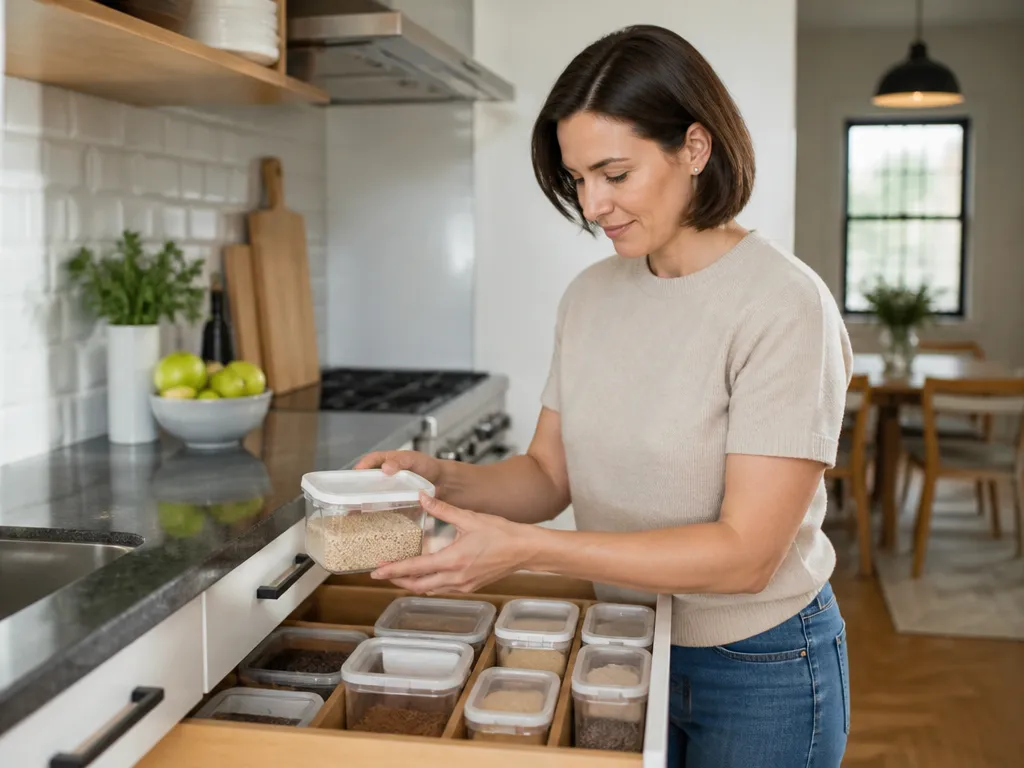
You need fewer storage containers than you think. Extra containers create extra lids, mismatches, and “temporary” stacks. For two people, choose container sets by category and keep overflow contained. This keeps the cupboard from filling with almost-compatible parts.
Start with an inventory sweep. Count food storage containers, including the “mystery stack” with broken or missing lids. Keep containers based on lid integrity and shape. Discard anything that does not seal reliably, or use it for a non-food purpose such as temporarily organizing small pantry items. A system based on “maybe this lid fits” will not hold up.
Use this practical container budget:
- Leftovers, daily or weekly: enough containers for 2-3 meal portions per person.
- Snacks: one dedicated bin or drawer, not several half-empty bags.
- Dry pantry storage: use containers only for foods that benefit from them, such as rice, flour, cereal, or pasta if you prefer.
Give containers and lids a shared home so they do not separate. Store lids vertically next to matching bases, or use a lid-and-base stack that lets you remove both together. If you mix lid types, keep them in one “fits most” bin only if you can tolerate occasional mismatches.
| Category | Keep | Backup limit | Why it matters |
|---|---|---|---|
| Leftover containers | 10-16 total | 2-4 extra | Covers typical weeks without lid chaos |
| Snack containers | 1 bin per snack type | None | One destination stops “bag sprawl” |
| Dry goods jars | 3-6 biggest items | 1-2 extra | Jars reduce clutter only when used consistently |
| Baking storage | 1-2 bins | 1 bin | Flour and sugar overflow is usually seasonal |
If you both meal prep and regularly store leftover rice and sauces, keep more shallow containers and fewer deep ones. If only one person meal preps, give that person a private set near the fridge to reduce rearranging and unnecessary handling.
If you keep buying containers because you “need one more,” the problem is probably backup capacity rather than a lack of containers. Enforce the existing limit and stop adding containers until the overflow stabilizes.
Where Should Cooking Tools Live?
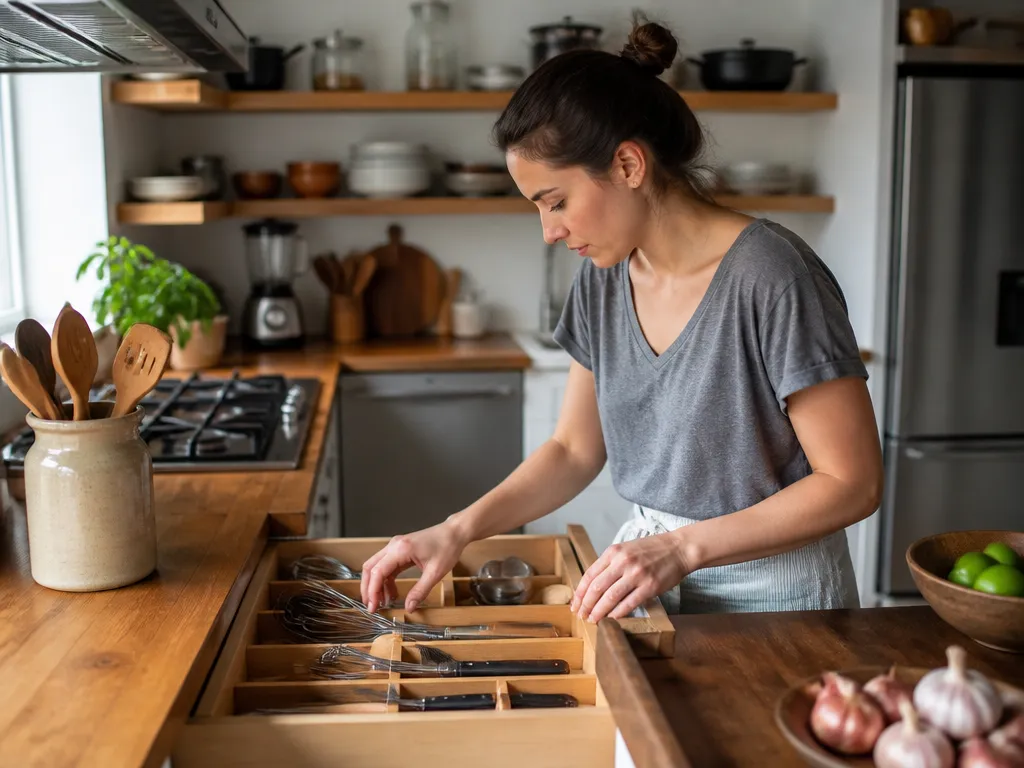
Place cooking tools according to hand movement, not cabinet layout. A tool used during active cooking belongs within shared reach near the stove or prep surface. An occasional tool can live deeper in a cabinet because you do not need it mid-meal.
Separate tools by how often you grab them:
- Daily or weekly tools: spatula, tongs, ladle, whisk, measuring cups, can opener if you use one, and everyday knives.
- Occasional tools: stand mixer attachments, specialty gadgets, cake pans, and a mandoline if you use it less often.
- Seasonal tools: holiday baking pans, roasting racks, and ice cream tools.
Put daily tools in the stovetop and prep zone – the drawers closest to the stove knobs and the counter where you chop. If the stove is against a wall, use the drawer on that side first. Keep knives on a magnetic strip if that is already your setup, and store extra boards and occasional knives nearby without letting them compete for daily space.
Most two-person kitchens work well with:
- A shared utensil drawer for tools used mid-cook.
- A private knife or tool bin for each person for personal favorites, such as a preferred seasoning shaker.
- A shallow measuring-tools drawer for cups and spoons, which you may grab even when you are not following a formal recipe.
When tools overlap, assign one person responsibility for the physical storage location while keeping access open to both people. For example, one person might manage the blender-cup bin. The cups and attachments stay together in one labeled cabinet, even if both people use them.
If the utensil drawer is always messy, the problem may be the tool mix. Put flat utensils such as spatulas and wooden spoons in one organizer insert, and small tools such as whisks and measuring spoons in another. Mixing them forces you to dump everything in because small pieces fall and larger ones wedge.
With limited drawer space, use one single-height bin instead of many small organizers. The goal is easy restoration: people are more likely to put things away when it takes less than 10 seconds.
How to Set Up Pantry and Fridge Systems
A useful pantry and fridge system separates everyday items from overflow and backups. That boundary reduces digging, duplicate purchases, and the daily question of where something belongs.
Arrange pantry storage by frequency:
- Top shelf: rarely used items, such as seldom-used spices and seasonal baking supplies.
- Middle shelves: everyday cooking ingredients, including oils, vinegars, pasta shapes, and canned goods.
- Bottom shelf or door shelf: snacks and backup basics that you can replenish without digging.
Use the same logic in the fridge. Keep daily items where both people can see them without kneeling or moving other food:
- Top shelf: drinks, condiments, and sauces.
- Middle shelf: frequently used produce.
- Lower shelves: dairy, prepared foods, and leftover containers.
Give the fridge one incoming spot and one leftover spot. Incoming groceries go in the first location after shopping. Sealed containers for tomorrow go in the second. Without those boundaries, new groceries and leftovers become one crowded pile.
Choose one pantry container rule. If you use jars or bins for dry goods, keep the number small and use one label style – either “date + name” or “name only.” If you keep original packaging, corral it in one bin per category, such as a basket for breakfast cereal and granola.
Set up the system in about an hour:
- Measure cabinet shelves and choose containers that fit without wasted gaps.
- Add one bin per category: snacks, baking, rice and pasta, and canned goods.
- Label bins by category, not by brand.
- Set aside a backup shelf for items that are running low.
If opened bags of chips keep multiplying, create one “chips home” bin and store chips nowhere else. The same rule works for bread, wraps, and tortillas.
If the pantry looks neat on day one and messy by week two, you probably have too many door-storage exceptions. Door space is easy to access, so items tend to multiply there. Limit it to condiments and one snack category, then move other items to labeled shelf bins.
Restocking determines whether the system holds. Whoever empties a bin checks it during their next trip, and both people restock once at the same time each week rather than reacting after every meal.
What Weekly Reset Routine Keeps Order?
A weekly reset catches the slow drift that daily habits create. Even careful people eventually leave tools on the counter or place groceries in the nearest open space. A short reset prevents those small exceptions from becoming the new system.
Schedule a 10-15 minute reset on the same day each week. Choose a time after the last meal-prep session so you can clear crumbs, wipe counters, and reset the fridge’s incoming spot. Keep the routine short enough to repeat and strict enough to address root problems such as overflowing containers or misplaced tools.
Use this checklist:
- Return all bins to their labeled zones.
- Re-home tools left on counters or in the random drawer.
- Check overflow: use items down or remove duplicates if a backup spot is full.
- Wipe and clear surfaces in the prep and stovetop zones.
- Write the next restock note for anything that ran out.
If the backup snack bin fills every weekend, the bin may be too small or may contain the wrong categories. During the reset, remove unused items, move misplaced foods to the correct category, or reduce the amount you store there.
If one person always handles the reset, switch responsibility weekly. One person can lead the reset while both complete the final sweep together. Rotating the lead keeps the system from becoming a chore assigned to the tidier person.
Make only one change after each reset, and only when you find a repeated failure. Move one category closer to its use zone or remove one duplicate container set. Changing one variable at a time makes it easier to tell whether the adjustment worked.
How to Handle Overlapping Storage Conflicts
Storage conflicts occur when two people claim the same convenient space or disagree about what belongs there. Fix them with unambiguous category homes and one clear rule for exceptions.
Identify the categories causing friction. Common examples include:
- Which shelf is for snacks?
- Where do leftovers go?
- Who owns the blender cups?
- Where do spices go during a recipe?
Make shared homes category-based rather than person-based, except for private bins. Shared snacks belong in the snack bin, not on whichever shelf happens to be empty. Shared leftovers belong in the designated leftover spot and nowhere else.
When an overlap keeps happening, use a swap-based fix instead of a lecture. If one person moves the cutting board because they want it near the sink, test a new home near the prep area. Change the layout before trying to change the person.
Keep a conflict log for one week. Record each item moved to the wrong spot and where it seems to belong. At the end of the week, change homes for only the top 3 problems. This prevents endless tweaking.
| Problem | Likely cause | Fix that works |
|---|---|---|
| Snacks spread everywhere | Door and counter have no boundary | Move snacks to one labeled bin and remove them from the door |
| Leftovers vanish | No designated leftover spot | Create one leftover shelf and label it clearly |
| Tools stay on counters | Tools are stored too far away | Move daily tools into shared reach near the stove |
| Lids go missing | Lids are stored separately | Store lids with matching bases or add a lid-bin rule |
If lids disappear, you do not need more storage. You need a lid policy: keep each lid with its matching base. If the lids cannot be matched, store all mismatched lids together in one labeled “misc lids” unit and treat it as a temporary system.
Store sharp tools and heavy cookware so they remain stable and easy to put away. If drawers only close when you shove items inside, the layout is creating a safety risk and needs to change.
Run a one-week “no new category” rule after making the fixes. Adjust homes and overflow rules, then leave the rest alone until the kitchen works correctly through multiple meals.
FAQ
How much time does it take to organize a kitchen for two people?
A realistic first pass takes 2-4 hours when sorting and labeling are included. The weekly reset should take 10-15 minutes because it involves returning items to labeled homes and checking overflow spots. If you feel you need to organize again after a few days, you probably created too many homes or kept too many duplicates.
What’s the cheapest way to organize a kitchen for two people?
Start with labels, drawer separators, and existing containers before buying new ones. If you make one purchase, choose matching bins for snacks and leftovers, since those categories tend to drift. Skip specialty organizers until you assign homes; otherwise, you may buy storage for the wrong layout.
Is it better to share all storage or give each person separate bins?
Give each person separate bins for personal categories, but share the cooking zones near the stove and prep surfaces. Sharing everything creates overlapping “temporary” storage and more misplaced items. Private bins reduce friction around coffee gear, lunch containers, personal tools, and other preferences.
What should we do when we keep disagreeing about where items go?
Create category-based homes with simple labels, then choose one explicit rule for exceptions. For example, sending incoming groceries to one incoming shelf keeps the fridge from becoming a moving target. If the conflict continues, change the physical location. Repeated behavior often points to a poor layout rather than unwillingness to follow the system.
What’s the most common mistake when organizing for two people?
The most common mistake is storing too many containers and expecting perfect behavior. Multiple “almost right” options cause lids to separate and items to migrate to counters.